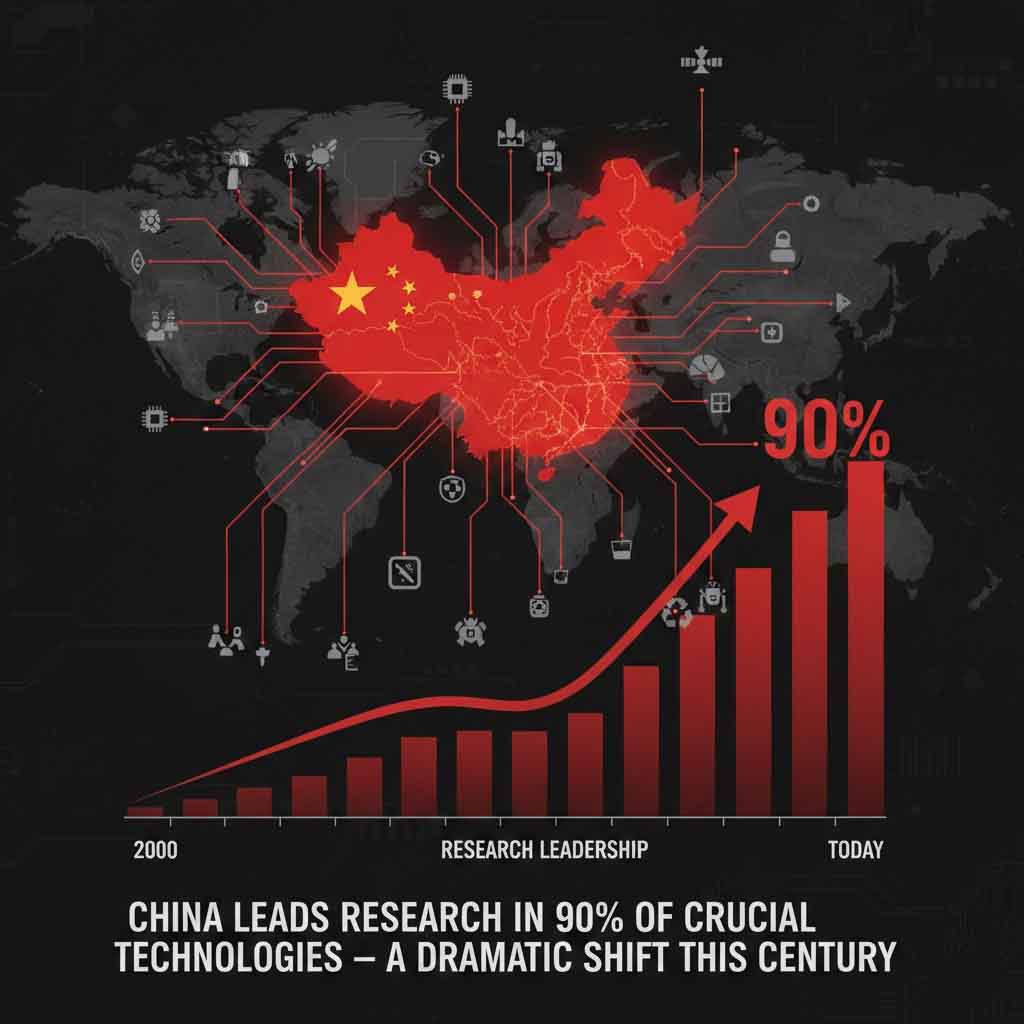
China Leads Nearly 90% of Key Technologies
.png "Department of Strategic Monitoring")
China is leading global scientific research across the overwhelming majority of critical and emerging technological domains, according to the latest update of the Australian Strategic Policy Institute’s (ASPI) Critical Technology Tracker. The data show that Beijing holds leading positions in nearly nine out of ten technologies analyzed — ranging from artificial intelligence and next-generation computing systems to biotechnology and advanced materials. This outcome reflects not a one-off surge, but a sustained transformation of the global scientific and technological landscape. ASPI stresses that the focus is on high-impact research that underpins future military, economic, and strategic capabilities of states. In this sphere, China has built over recent years a large-scale, coordinated ecosystem of science and innovation that increasingly defines the contours of global technological competition.
Scientific Superiority as a New Form of Power
These findings matter because they shift the focus of power away from current troop deployments and hardware toward long-term scientific dominance, which shapes tomorrow’s military, economic, and strategic advantage. For several years, ASPI has conducted a systematic assessment of global leadership in high-impact research across technologies directly linked to national security and economic competitiveness. The 2025 update does more than expand the dataset — it confirms the consolidation of a deep structural shift in the global distribution of technological power.
China as a Global Center of Scientific Gravity
In its 2025 edition, the Critical Technology Tracker assesses 74 technologies, up from 64 in the previous cycle. The analysis draws on publications from 2020–2024, along with early trends observed in 2025. Breakthrough research is identified through the top 10% most highly cited scientific papers. The conclusion is unequivocal: China leads in 66 out of 74 technologies, or close to 90%. The United States retains leadership in only eight areas, among them quantum computing and geoengineering. This is not a temporary spike, but a systemic advantage supported by a broad and consistent body of evidence.
New Fields, the Same Trajectory
Ten new domains were added to the latest report, such as generative artificial intelligence, computer vision, neuroprosthetics, brain–computer interfaces, and geoengineering. China leads in eight of these newly tracked fields. This point is critical. China’s advantage is not confined to legacy industrial sectors; it extends into fast-evolving areas that will shape the architecture of future economies, armed forces, and governance systems. ASPI notes that China’s lead is often measured not in marginal percentages, but in multiples: Chinese institutions produce far more high-impact research than their closest competitors.
Institutional Concentration and the Risk of Dependency
The institutional structure behind this leadership also stands out. The Chinese Academy of Sciences consistently ranks among the world’s top institutions across multiple technological areas, reflecting scale effects and a centralized national investment strategy. ASPI explicitly warns of “monopoly risks” in certain fields, where China hosts the majority of the world’s leading research organizations and talent pipelines. Over the long term, this could create technological dependencies for other states — not through coercion, but through the absence of viable alternatives.
A Historical Break
The contrast with the recent past is striking. Between 2003 and 2007, the United States led in more than 90% of the technologies now tracked, while China’s share was below 5%. ASPI reports from 2023–2024 already showed China leading in 57 of 64 technologies. The current data confirm not a sudden leap, but the consolidation of a new balance of power. ASPI attributes this shift to decades of sustained investment in R&D, strategic policy planning, and the return or retention of researchers trained abroad.
What Matters to Understand
ASPI emphasizes that research leadership is a leading indicator, not a direct measure of deployed or commercialized capability. The United States still maintains strengths in certain areas, such as vaccine technologies, small satellite systems, and specific quantum applications.
Yet this is precisely why the tracker is so closely studied in government and analytical circles. It functions as an early warning signal, indicating where future technological and strategic advantages are likely to emerge. The conclusion is clear: competition for influence is increasingly shaped not by today’s force posture, but by control over the scientific foundations that will define power over the next ten to twenty years. In this dimension, the world is already operating in a new reality.