The $11 Billion Taiwan Package
.png "Department of Strategic Monitoring")
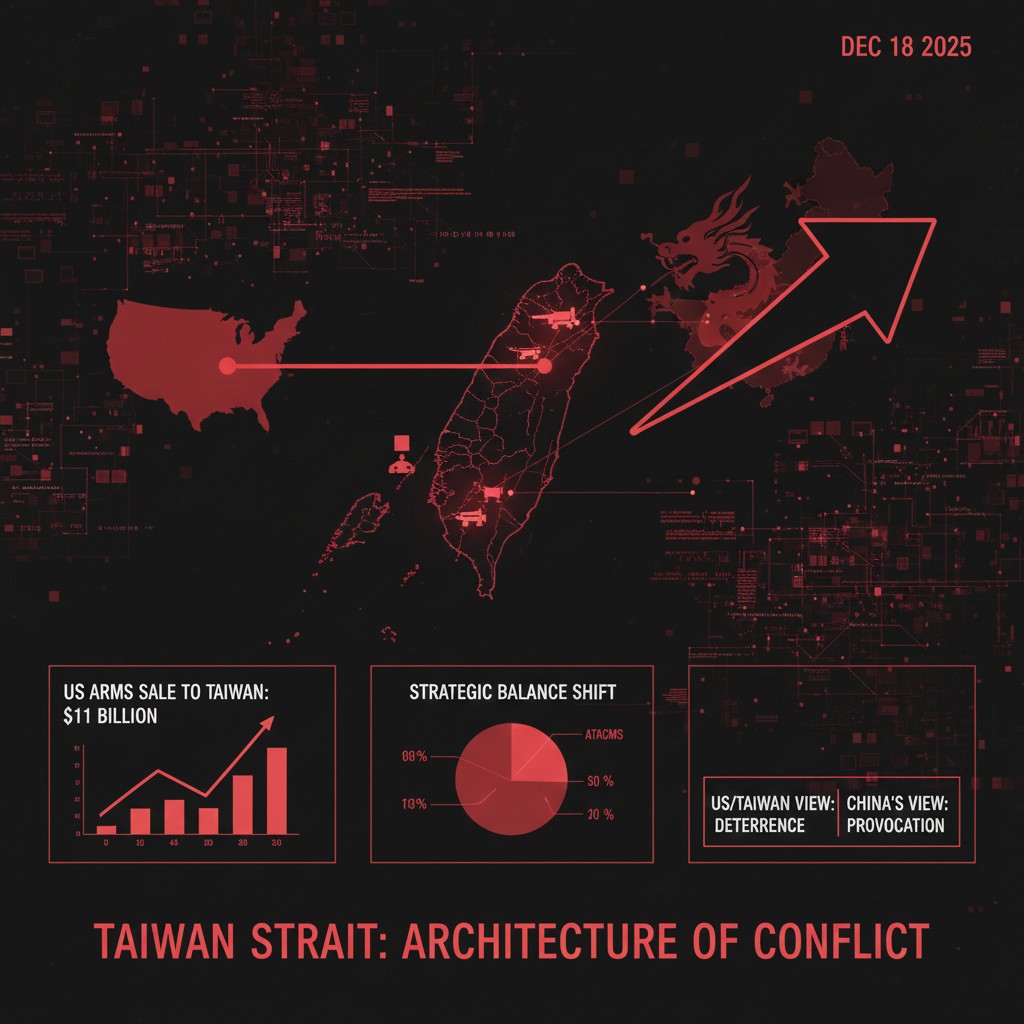
The $11 Billion Taiwan Package: Technological Leaps, Operational Risks, and the Architecture of New Deterrence
The events of December 2025 regarding the U.S. Congressional notification of a massive arms sale to Taiwan represent a watershed moment in the military-technical cooperation between Washington and Taipei. While the procedure adheres to the framework of the 1979 Taiwan Relations Act (TRA), the qualitative characteristics of the systems involved suggest a fundamental revision of the "defensive weapons" concept.
This reconstruction aims to detail the package's composition, analyze the operational consequences, and identify the hidden nodes of tension that remain absent from official press releases.
I. Anatomy of the Package: From Passive Defense to "Active Inhibition"
The official list of armaments, valued at over $11 billion, includes components that, when integrated, create a multi-layered strike contour. Analysis of the nomenclature reveals three key vectors:
1. Deep Strike Capability
- HIMARS and ATACMS: The delivery of additional launchers and tactical missiles with a range of up to 300 km.
- Technical Fact: This enables Taiwan to reach mainland China's coastline, including port infrastructure and troop concentration areas. For the first time, the "deterrence distance" is pushed beyond the island's territorial waters.
- M109A6 Paladin: Self-propelled howitzers providing high mobility.
- Logic: In an environment of enemy air superiority, artillery survival depends on the speed of repositioning ("shoot-and-scoot").
2. Autonomization and the "Swarm"
- Unmanned Systems: A significant portion of the budget is allocated to loitering munitions (suicide drones) and reconnaissance UAVs.
- Version: Lessons from recent global conflicts suggest that inexpensive drones are more effective at protecting a coastline than costly frigates, which are vulnerable to missile saturation.
3. Digital Connectivity
- Link-16 and Software: Upgrades to data transmission systems.
- Hidden Aspect: This is the most sensitive part of the deal. Integrating Taiwanese systems into U.S. data exchange protocols de facto creates a unified information field. This raises the question: Will Taiwan receive real-time targeting data from U.S. satellite constellations?
II. Taipei: The "Porcupine Strategy" 2.0
For the Lai Ching-te administration, this deal is not merely a procurement but the realization of the "Asymmetric Warfare" doctrine.
Verified Facts:
- Taiwan is shifting toward decentralized ammunition storage and the creation of highly mobile combat groups.
- The procurement budget is synchronized with a reserve force reform and an extension of mandatory military service.
Unanswered Question: Does Taiwan possess sufficient trained personnel to operate ATACMS and high-tech UAVs without a permanent presence of U.S. advisors on-site? Official sources ignore this, citing "standard training programs."
III. Beijing: Paradigm Shift in Response
The PRC's response in December 2025 took on new characteristics. Beyond traditional diplomatic protests, there is a shift toward a "comprehensive pressure" strategy.
- Economic Tooling: Beijing has initiated investigations into U.S. defense contractors (Lockheed Martin, Raytheon), imposing sanctions on executives and restricting access to rare-earth metal supply chains.
- Military Activity: There is a recorded increase in "median line" crossings in the Taiwan Strait not only by aircraft but by maritime reconnaissance drones, interpreted as stress-testing the island's new defense architecture.
Analyst Perspective: Beijing views 2025 as the point after which the "window of opportunity" for peaceful reunification begins to close due to Taipei’s technological rearmament. This increases the risk of preemptive "gray zone" actions (blockades, cyberattacks).
IV. Washington: Between Procedure and Escalation
The Trump administration positions the sale as a business project ("creating U.S. jobs") and the fulfillment of security obligations. However, beneath the "business logic" lies a strategic calculation.
Zones of Ambiguity:
- Delivery Timelines: Congressional approval does not mean immediate delivery. Many systems have production cycles of 2–4 years.
- Political Leverage: There is a theory that the scale of the package is used by Washington as leverage against Beijing in trade negotiations. Weaponry becomes a "bargaining chip" in a larger geopolitical transaction.
V. Critical Nodes and Unanswered Questions
Despite the transparency regarding figures and system names, the "$11 Billion Project" leaves several gray areas:
- Integration or Autonomy? How autonomously can Taiwan use ATACMS missiles? Are there software-coded "geofences" preventing strikes on specific PRC mainland targets?
- Logistical Resilience: In the event of a real blockade, how would the island replenish stocks of expensive missiles, given that U.S. production capacity is limited?
- Beijing’s Red Lines: Is the $11 billion figure the critical threshold, or will the physical arrival of the first HIMARS batch serve as the trigger?
- Internal Opposition: How will the deal affect Taiwan's internal politics, specifically the Kuomintang (KMT) party, which advocates for de-escalating tensions with Beijing?
Summary
The 2025 arms sale to Taiwan is not a linear continuation of old policies but a qualitative leap. The U.S. is effectively providing Taipei with the tools to take combat operations to the adversary’s doorstep, radically altering the cost-benefit analysis of a potential conflict for Beijing.
The situation has entered a phase of "dynamic waiting": while all parties have staked their positions, the actual stability of this framework will be tested not in boardrooms, but in logistics ports and training ranges over the next 18–24 months.
Sources:
- Official Notifications from the DSCA (Defense Security Cooperation Agency).
- U.S. Congressional Research Service (CRS) Reports on Taiwan.
- U.S. Department of Defense Annual Report on PRC Military Power (2025).
- Statements from Taiwan’s Ministry of National Defense (MND).
- Analysis from the South China Morning Post and CSIS.