U.S. Expands Travel Restrictions
U.S. Expands Travel Restrictions: 20 More Countries and the Palestinian Authority Added to Entry Bans
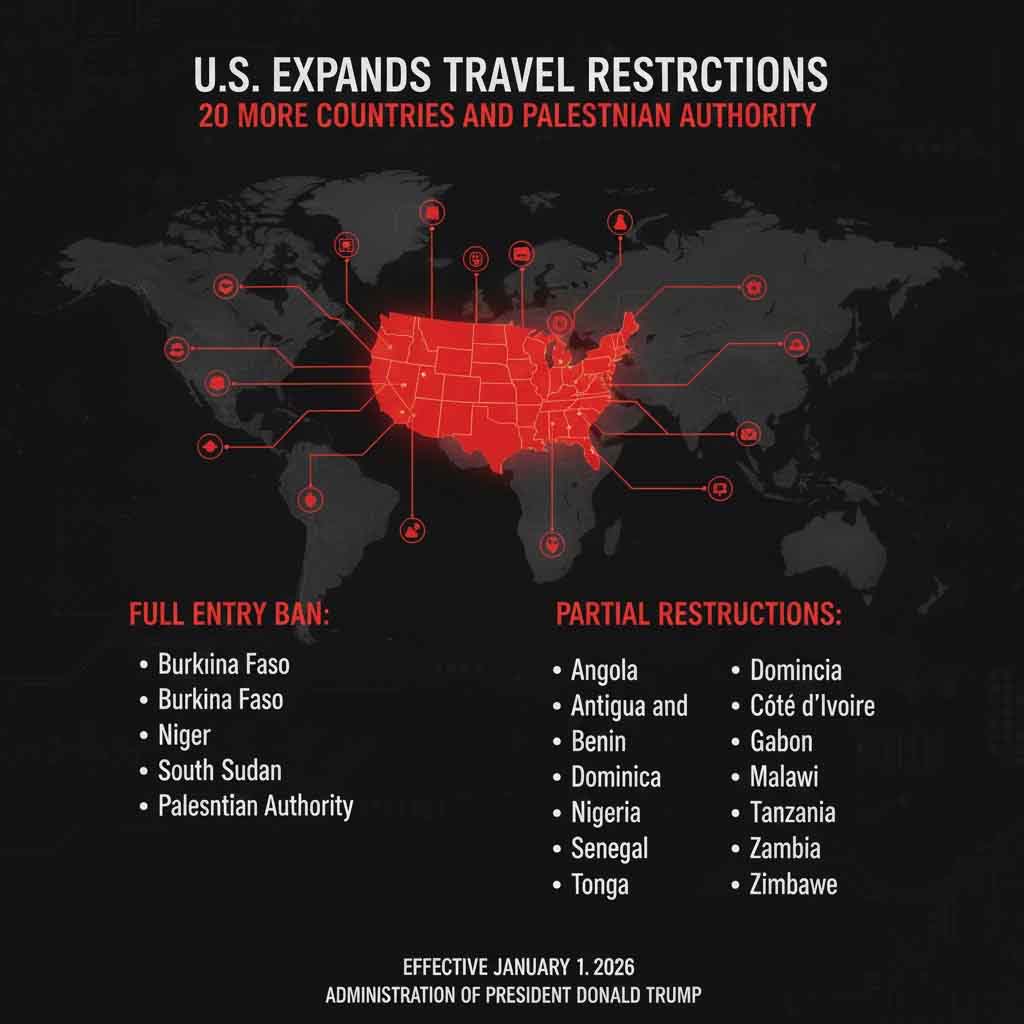
The administration of President Donald Trump has announced a major expansion of U.S. entry restrictions, effectively doubling the number of countries and jurisdictions subject to tightened travel rules. The new measures will take effect on January 1, 2026.
Under the latest decision, restrictions now apply to 20 additional countries, as well as to individuals traveling on documents issued by the Palestinian Authority.
Full Entry Ban: 5 Countries and the Palestinian Authority
Under the revised policy, the United States has imposed a full entry ban on citizens of five countries:
• Burkina Faso
• Mali
• Niger
• South Sudan
• Syria
In addition, entry is now barred for individuals using travel documents issued by the Palestinian Authority, marking a further tightening of restrictions affecting Palestinian travelers.
South Sudan, which had already been subject to extensive travel limitations, remains under strict controls within the updated framework.
Partial Restrictions: 15 Additional Countries
At the same time, Washington introduced partial travel restrictions on citizens of 15 countries, affecting both short-term travel and immigration pathways:
• Angola
• Antigua and Barbuda
• Benin
• Côte d’Ivoire
• Dominica
• Gabon
• Gambia
• Malawi
• Mauritania
• Nigeria
• Senegal
• Tanzania
• Tonga
• Zambia
• Zimbabwe
These measures apply to tourist and business visas as well as to applications for permanent residence.
Exemptions and Implementation
The administration clarified that the new restrictions do not apply to:
• holders of valid U.S. visas
• lawful permanent residents of the United States
• diplomats
• professional athletes
• certain individuals whose entry is deemed to serve U.S. national interests
Decisions on individual exemptions will be made on a case-by-case basis.
Security, Documentation, and Deportation Concerns
U.S. officials said the expanded restrictions are based on a combination of factors:
• unreliable or fraudulent civil documentation
• insufficient criminal record systems
• high levels of corruption
• elevated rates of visa overstays
• refusal by some governments to accept deported nationals
• political instability and weak state institutions
The White House emphasized that the measures reflect assessments by security agencies, immigration authorities, and foreign policy institutions.
Continuation of a Core Trump Policy
The decision extends one of President Trump’s most controversial policy lines from his first term.
In June 2025, the administration had already imposed full entry bans on citizens of 12 countries:
• Afghanistan
• Myanmar
• Chad
• Republic of Congo
• Equatorial Guinea
• Eritrea
• Haiti
• Iran
• Libya
• Somalia
• Sudan
• Yemen
An additional seven countries were placed under enhanced restrictions at that time:
• Burundi
• Cuba
• Laos
• Sierra Leone
• Togo
• Turkmenistan
• Venezuela
With the latest expansion, the total number of countries and jurisdictions affected by U.S. travel restrictions has more than doubled within a single year.
Conclusion
The widening of entry bans underscores the Trump administration’s commitment to strict migration control and heightened border enforcement. Security considerations, administrative control, and unilateral standards for entry remain at the core of U.S. policy, despite the diplomatic consequences and rising international friction associated with the measures.