Greece Strengthens Aegean Defense

Greece Strengthens Aegean Defense: Israeli Spike NLOS Missiles Deployed on Islands and Along the Turkish Border
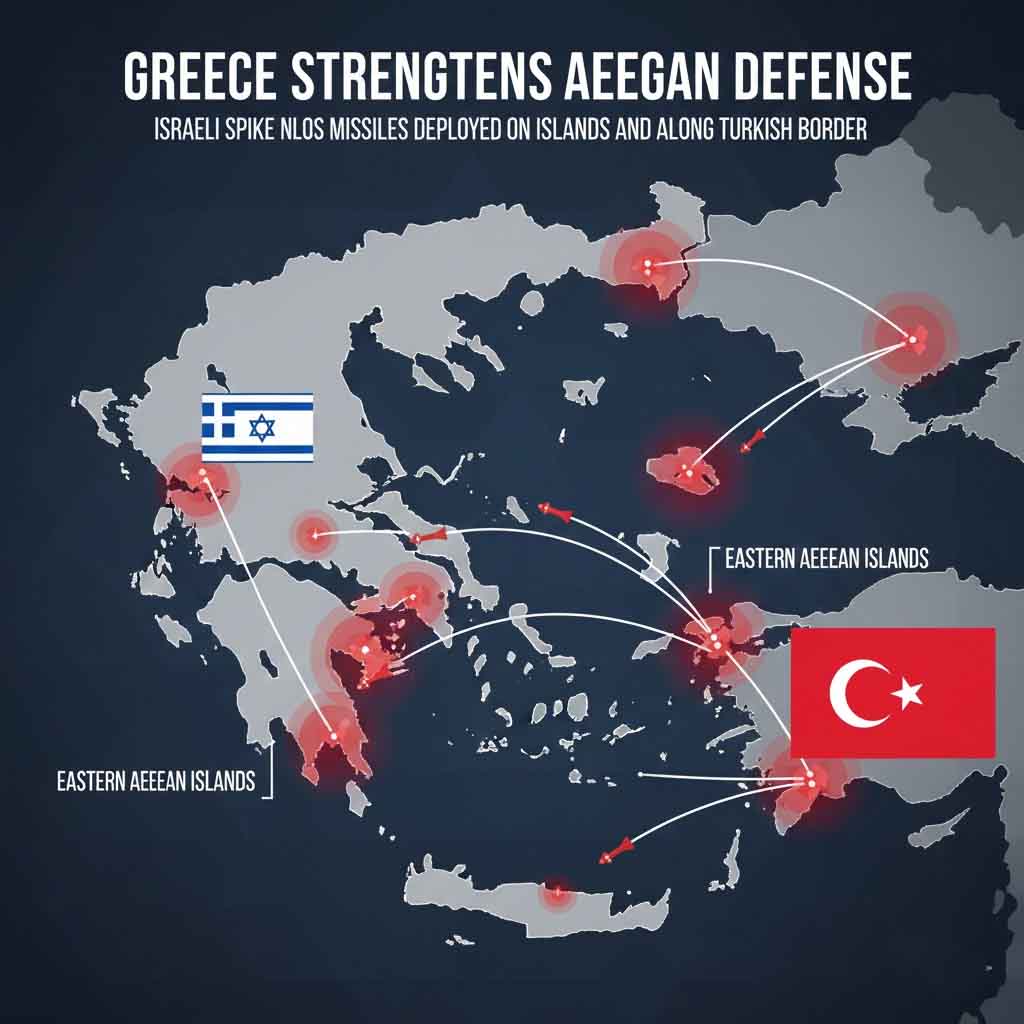
Greece is steadily reinforcing its national defense and deterrence posture in key areas of the Eastern Mediterranean. By late 2025, the Hellenic Armed Forces formally brought Israeli-made Spike NLOS missile systems into operational service, deploying them on the Eastern Aegean islands and along the land border with Türkiye at the Evros River.
Deliveries began in August 2025 under a multi-phase procurement agreement with Israel’s Rafael Advanced Defense Systems, and by the end of the year the systems were reported as fully operational in both island and border configurations.
A Major Leap in Long-Range Precision
The Spike NLOS (Non-Line-of-Sight) missile provides the Hellenic Army with a high-precision strike capability at ranges of up to 32–35 kilometers, depending on platform and configuration.
Equipped with electro-optical and infrared guidance, the system allows operators to detect, identify, and adjust targets beyond direct line of sight. Unlike conventional anti-tank guided missiles, Spike NLOS is designed for deep engagement in complex terrain, enabling strikes against armored vehicles, command posts, and landing forces while keeping launch units outside the enemy’s immediate reach.
Greek defense sources describe the system as a core element of a broader effort to modernize land-based deterrence.
Aegean Islands as A2/AD Strongpoints
On the Eastern Aegean islands, the missiles are positioned to counter potential amphibious or air-mobile operations. Greek defense media characterize the deployments as effectively transforming selected islands into layered anti-access/area denial (A2/AD) zones, capable of delivering preemptive or rapid-response precision strikes far beyond coastal defenses.
These islands lie in close proximity to Türkiye’s western coastline, a region long central to disputes over maritime boundaries and military posture.
Athens consistently stresses that the sovereignty of the islands and their right to self-defense are non-negotiable, rejecting Ankara’s interpretations of the 1923 Lausanne Treaty and the 1947 Paris Peace Treaties.
Evros: Expanding Defensive Depth
Along the Evros River border, Spike NLOS systems are intended to counter mechanized formations and suppress advancing forces at extended ranges.
Their reach allows Greek units to engage targets well before they approach the border line, significantly increasing defensive depth and reducing vulnerability to sudden or massed movements.
In 2025, Greece received an initial batch of 17 Spike NLOS systems as part of a broader procurement package valued, across phases, at between €50 million and €400 million.
Networked Integration and Allied Synergy
The acquisition includes not only missiles, but also launchers, dedicated vehicles such as Sandcat platforms, fire-control centers, and full integration into C4I networks.
The systems are linked with unmanned aerial platforms, including Orbiter 3 drones, used for target acquisition and battle damage assessment. Spike NLOS is also compatible with Apache attack helicopters, further expanding operational flexibility.
Conclusion
The deployment of Spike NLOS underscores a measured, technologically grounded approach by Athens to national security. Greece is not pursuing escalation, but building a resilient deterrence architecture based on precision, range, and advanced integration.
Amid a complex regional security environment, this decision strengthens Greece’s defensive posture, enhances the protection of its islands and borders, and reinforces its role as a responsible and strategically mature actor in the Eastern Mediterranean.